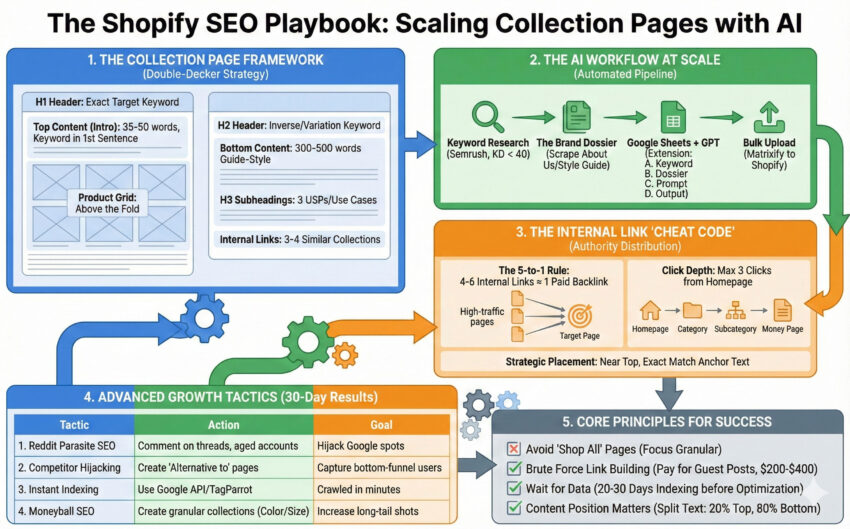
The Shopify SEO Playbook: Scaling Collection Pages with AI
This guide summary outlines the high-velocity “Growth Engine” model for Shopify SEO, popularized by Kai Cromwell of New Seas Shopify SEO Agency. Instead of waiting 12 months for results, this playbook focuses on building optimized collection pages at scale using AI and strategic internal linking.
1. The Collection Page Framework
Google needs textual context to rank a page, but users need a clean shopping experience. The “Double-Decker” strategy satisfies both.
Page Structure
- H1 Header: Must contain the exact target keyword (e.g., Men’s Waterproof Watches).
- Top Content (The Intro): 35–50 words maximum. The target keyword must appear in the first sentence.
- Product Grid: Placed immediately after the intro to keep products “above the fold.”
- H2 Header: An inverse or close variation of the target keyword.
- Bottom Content: 300–500 words of detailed guide-style content.
- H3 Subheadings: Three sections focusing on Unique Selling Points (USPs) or specific use cases.
- Internal Links: Cross-link to 3–4 similar collections at the bottom of the page.
- Example Collections:
2. The AI Workflow at Scale
To build 50–100 collections in a matter of minutes, move away from the ChatGPT interface and into a spreadsheet-based automation.
Step-by-Step Execution
- Keyword Research: Use Semrush to find commercial/transactional keywords with a Difficulty (KD) < 40.
- The Brand Dossier: Scrape your “About Us” page and style guide. This “Dossier” is fed into the AI for every prompt to ensure the tone remains consistent.
- Google Sheets + GPT: Use the GPT for Sheets and Docs extension.
- Column A: Target Keyword
- Column B: Brand Dossier
- Column C: AI Prompt
- Column D: AI Output
- Bulk Upload: Export the finalized copy and use Matrixify to upload descriptions and meta-titles to Shopify in bulk.
3. The Internal Link “Cheat Code”
Internal links distribute authority (link juice) and are often more cost-effective than buying backlinks.
- The 5-to-1 Rule: 4–6 internal links from high-traffic pages are the rough equivalent of one paid backlink.
- Strategic Placement: Place links near the top of the source page.
- Anchor Text: Use exact or near-match keywords for the fastest ranking boosts.
- Click Depth: No “money page” should be more than 3 clicks away from the homepage.
4. Advanced Growth Tactics
To see results in 30 days or less, implement these high-leverage tactics:
| Tactic | Action | Goal |
| Reddit Parasite SEO | Comment on high-traffic threads using aged accounts. | Hijack top Google spots for competitive terms. |
| Competitor Hijacking | Create “Alternative to [Competitor]” or “[Brand] vs [Competitor]” pages. | Capture users at the very bottom of the funnel. |
| Instant Indexing | Use the Google Indexing API or a tool like RafyIndex. | Get pages crawled in minutes, not weeks. |
| Moneyball SEO | Create granular collections for every variant (Color, Size, Use Case). | Increase “shots on goal” for long-tail keywords. |
5. Core Principles for Success
- Avoid “Shop All” Pages: These are the least effective SEO pages. Focus on granular categories.
- Brute Force Link Building: Don’t wait for “natural” links. Pay for guest posts or link insertions ($200–$400 range) to move the needle.
- Wait for Data: Give new pages 20–30 days of indexing before making further optimizations based on Search Console data.
- Content Position Matters: Splitting text (20% top, 80% bottom) provides the best balance between SEO relevance and User Experience (UX).
Category: Ecommerce SEO